I have been
working from home for years, moving between the living room and kitchen, and
sometimes even my bed, depending on the light, the weather and what I’m working
on.
And I live
in a small home, with an open-plan kitchen/living room. It has been vital for
me to be able put everything away out of sight, when the work is done.
Personally, I have identified that as serving my self-care.
In an ideal world, our work would be out-of-sight (with the aim of also being out-of-mind) during our down-time. But the COVID crisis has forced hundreds of thousands of people across the globe to create an at-home work space, and for many there isn’t the luxury to situate it in a spare bedroom or other under-utilised room.
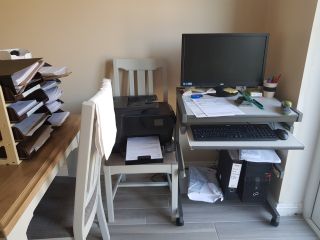
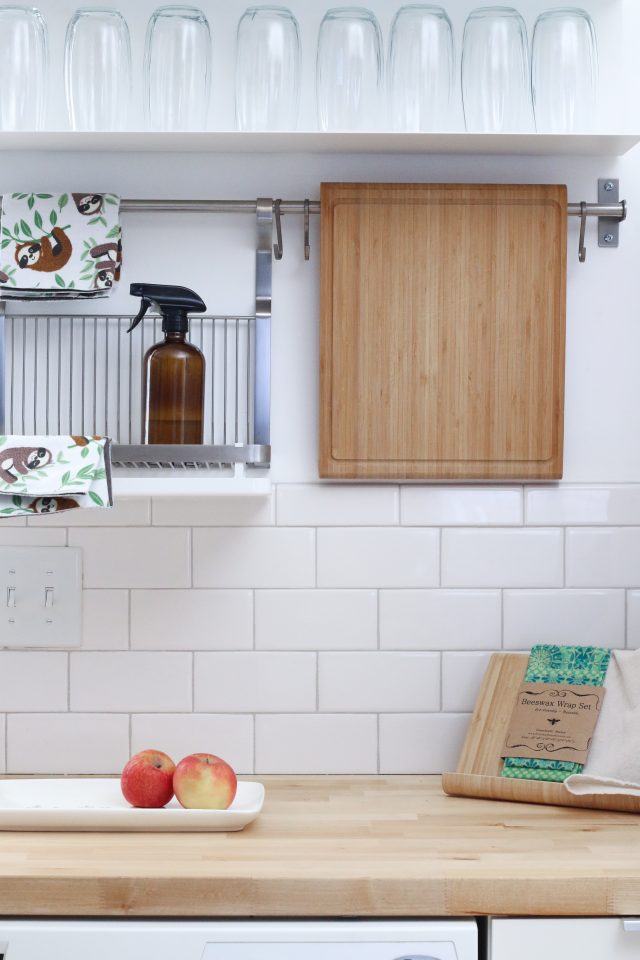
This image depicts a scene that is probably typical in many homes right now…and a scene that is likely to be ongoing for some time to come. If you are living with something like this, I would encourage you to explore ways of minimising this working view at the end of each day. Living with the obvious signs of our day’s work permanently in sight, is subconsciously draining.
It might be yet another time-consuming task to find and install a way of addressing it. But disguising, if not altogether hiding these visual cues when you’re officially off-duty will reap rewards.
Can you install wall shelves to move files and other paraphernalia off the kitchen table? Even if this doesn’t fit with your design plan and aesthetic, it is worth considering as a temporary measure. When the time comes that you no longer need to dedicate this corner of your home to work, you can remove the shelving and fill in the holes. Or keep them and replace the work paraphernalia with plants, art, books and attractive display items.
In the meantime, they can not only clear up space, improving the intended functionality of your dining table, but they can also facilitate storing vital supplies more stylishly. Choose shelving that blends with the room’s style, or paint them to blend in if you can’t find what you’d like within your budget.
Use attractive baskets and other containers to hide files and other work debris, bringing them down from the wall when you need them and returning them out of sight, and out of the way, when you’re finished with them.
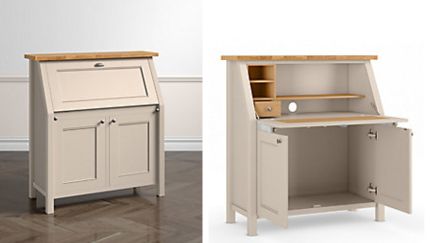
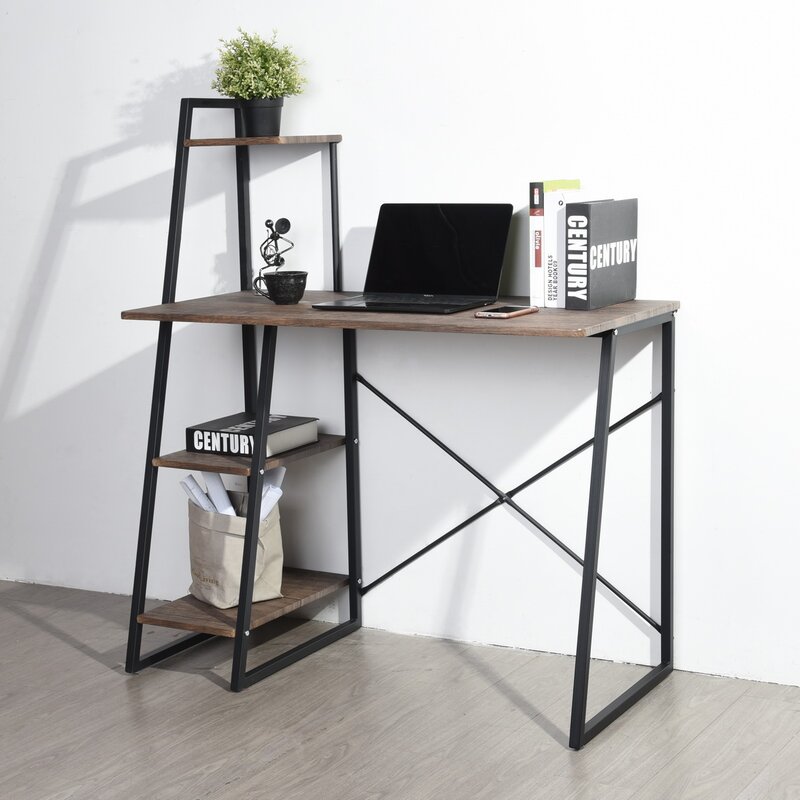
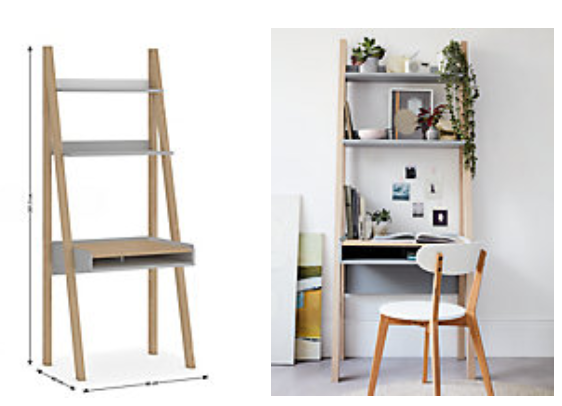
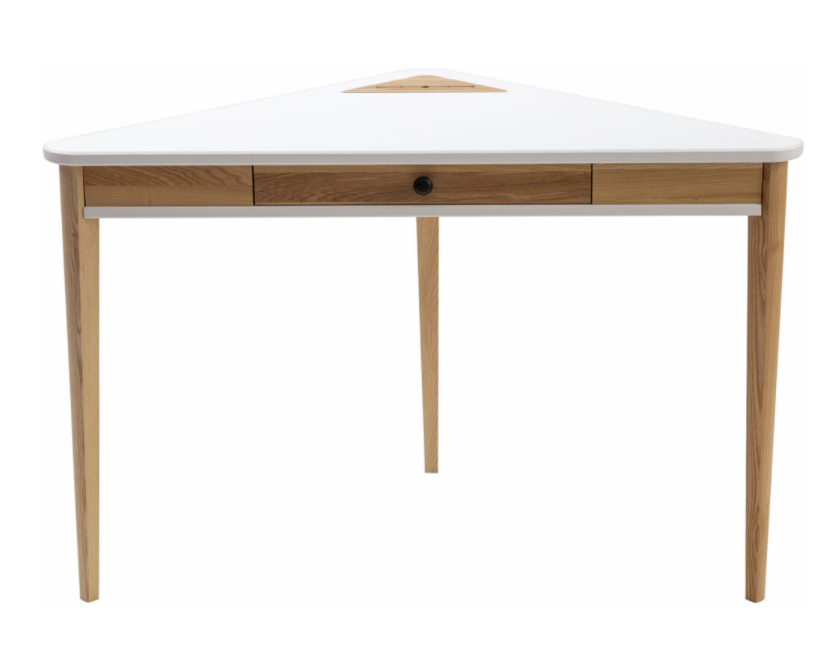
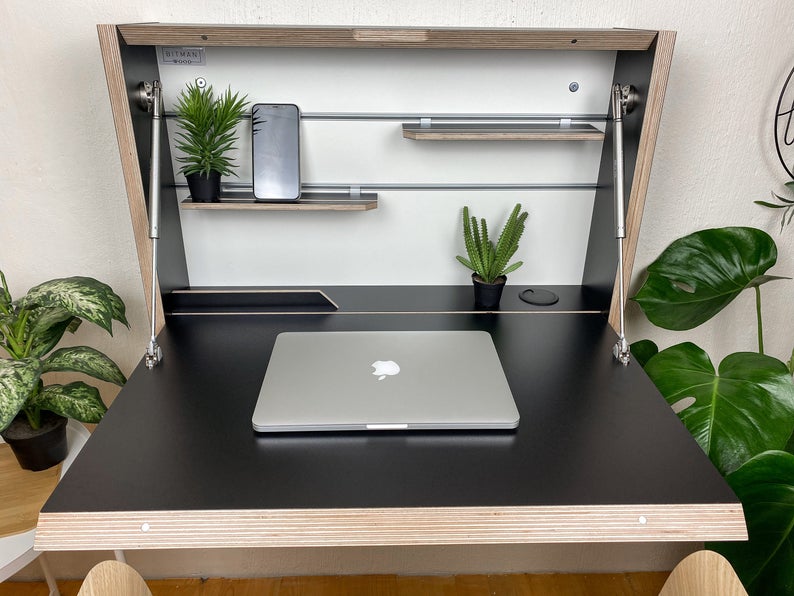
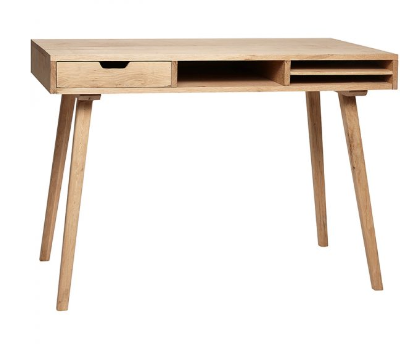
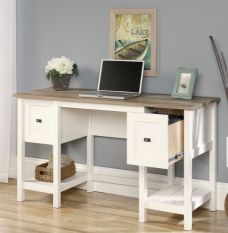
Replace an ugly computer desk with one that fits with your kitchen aesthetic and choose one that comes with built-in wall shelving, or under-desk drawers and cupboards where your files can live. There’s an abundance of options to suit different needs, from drop-downs to three-legged corner desks, and a wide selection of those that come with in-built shelving.
Following are just a few ideas available from high street stores or online:
Wayfair
Marks & Spencer
WooDesign
Etsy
WooDesign
The Range
With everything we’re dealing with right now, prettifying the corner of your home that you’re now working from may not feel like a priority. But I would urge you to seriously consider it. It may need to involve some financial outlay (perhaps your employer can cover that), but if spent smartly on the right pieces it can serve the dual purpose of meeting your work needs, while also serving your personal need for your home to also be a sanctuary in which you renew yourself after your working day.
Our self-care has never been more important. And having your work stuff always in plain sight, not to mention taking up everyday space, may be having a subconscious drain on your mental energy.
If you can’t
hide it completely, at least minimising what’s on sight, clearing stuff out of
the way, and presenting the area more attractively (and in keeping with your aesthetic)
will have a beneficial effect in this regard.
It doesn’t
have to be an instagrammable arrangement. Personally, I have simply dedicated a
kitchen cupboard to the everyday paraphernalia, while the paperwork I need to
access on an occasional basis lives in the hall cupboard.
Everyone’s set-up and needs will be different, but I highly encourage you to get creative and look for a solution rather then just living with it. It will make a difference to your wellbeing.
Last week Ireland’s House and Home magazine reported that their May/June issue was the best selling in ten years! Proof, if you needed it, that lockdown has significantly amplified the desire to update and upgrade our home décor.
I personally believe that loving our homes is an important
self-care practice. That involves caring for it regularly on the basic level of
cleaning, decluttering and organising. But it does also involve tweaking the
décor until it feels right and makes our hearts sing.
When you look around your home, if you feel it needs updating in some way but you’re not quite sure how to give it that elevated touch, I’m going to share a series of tips to help with that.
In this first post, we’re going to look at colour, which has the power to dramatically change the look and feel of a space even if you don’t do anything else.
I’ve already written a couple of posts to help choose your colour palette, and they’re linked at the end of this one. So what we’re going to look at here is not so much what colours you choose, but some atypical ways to apply them that will give your décor that little extra touch.
Let’s start at the top.
When it comes to ceilings, white isn’t the only way to go. And if it is what you decide on, you can still make subtle changes to the typical white ceiling.
Interior designers regard the ceiling as “the fifth wall”. And we make a conscious choice as to what colour to paint it. That’s not to say we won’t go with white. Often—and more often than not—we will.
However, designers probably won’t go with the common “brilliant white”. Especially if the plan is to paint the walls white too. They’ll consciously choose a particular white from a particular brand because they love the particular effect that it has in rooms with the same orientation as the one they’re working on.
To give your own home that elevated touch, make deliberate choices about every colour you apply to every surface—including the ceiling.
If you’re painting it white, avoid “brilliant” and choose something a little softer. And if you’re painting the walls white, get several samples and test them on each wall in the room before you make your final choice. And then paint the ceiling in the same hue.
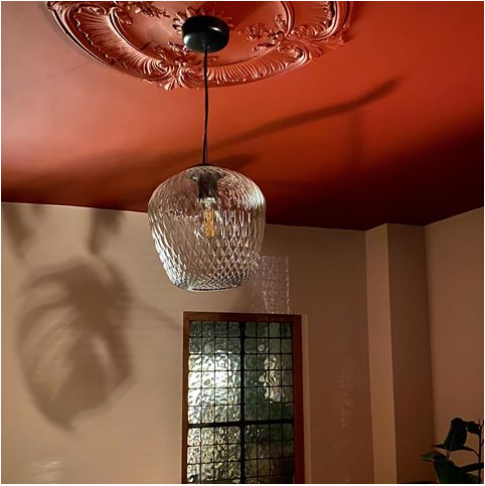
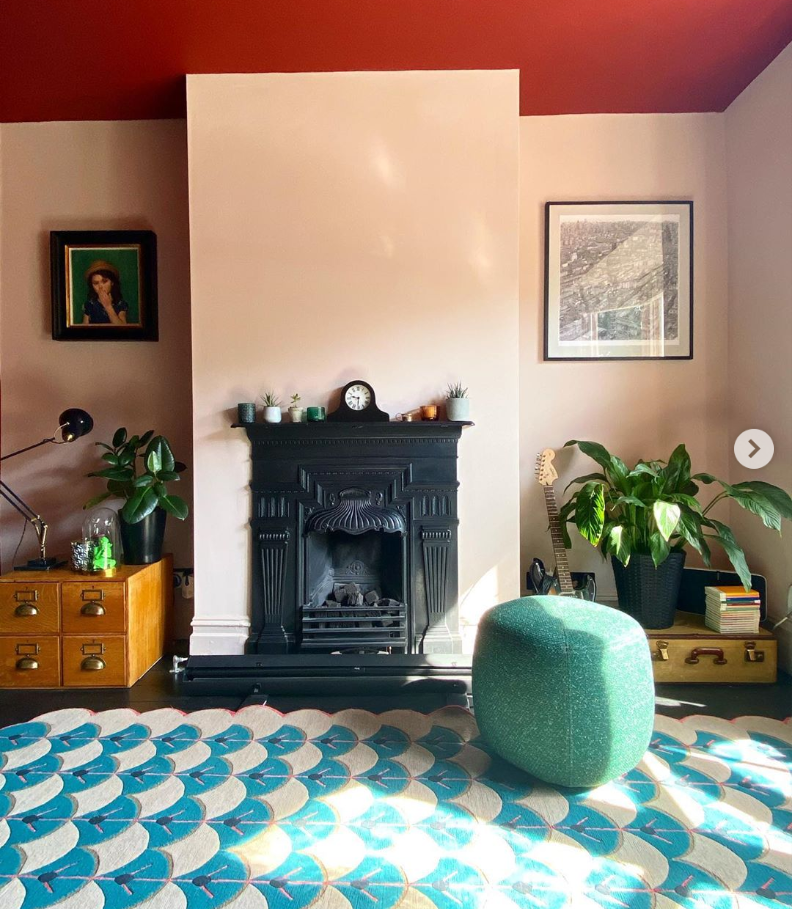
And if you want to get even bolder, consider using an actual colour on the ceiling instead of white! When a designer wants to make a strong statement in a room, this will be something they might include in the mix.
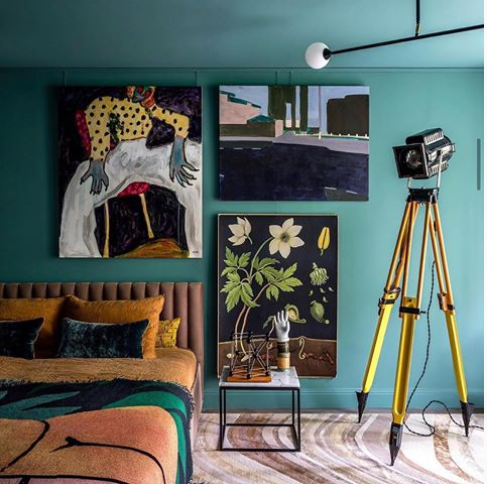
It’s a particularly good technique if you have a small, north-facing room that is never going to be a bright space no matter how many light-enhancing strategies you apply. You might hear a lot about “embracing the dark”, which designers will often recommend in these situations. It means intentionally designing the room to feel cosy and snug, instead of trying to make it feel lighter and brighter with pale colours, mirrors and other reflective surfaces.
If it’s a small space, with small windows and not getting any southerly light, going the cosy and snug route has the highest probability of success.
Painting the walls and ceiling a dark colour will help tremendously with that. But if that feels a bit too adventurous, you could paint the ceiling a paler tint of the wall colour, and still achieve that cave or womb-like feeling. It’s definitely something to consider, especially in rooms that are mostly used in the evening time.
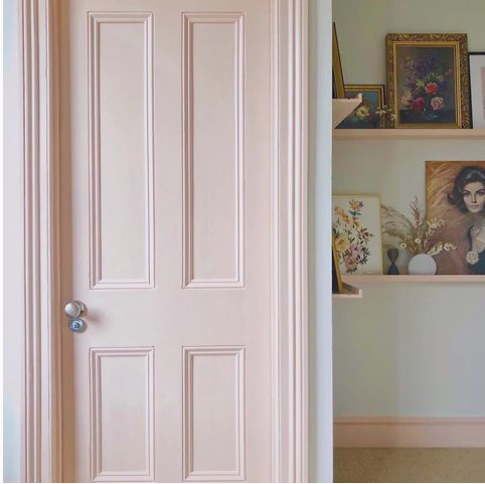
The Woodwork: Doors, Architraves and Skirting Boards.
For all of these surfaces white, again, is usually the default choice. For many of us, we didn’t even choose it. It was the builder’s finish and we’ve never thought to change it. When refreshing was required we simply stuck with the white.
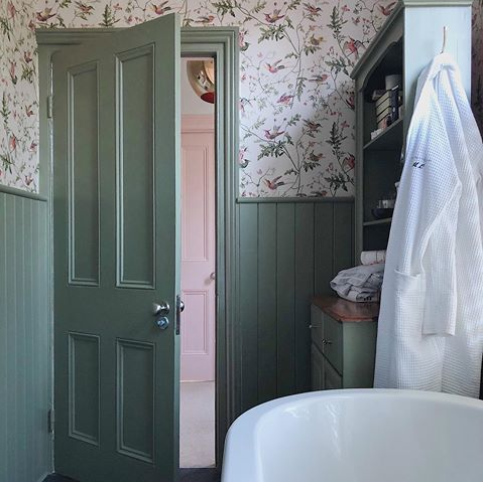
As with ceilings, I’m not saying to abandon white altogether. It really does depend on your wall colour. For example, if the walls are grey, then white doors and trims will look really smart beside them. I’m just saying, make a deliberate choice. There are lots more options besides white and natural wood. If your walls are green, search Pinterest for “green living room” and see what others have done with their doors and woodwork. Look for something that gives you a little lift and makes the décor around it sing.
Opting for colour instead of white on any of these surfaces will have an impact. If the room is on the small side and you want to increase the sense of space in it, then painting the doors, skirting, architrave and ceiling the same colour is a great trick to apply. It blurs the boundaries of the room, whereas a white ceiling and doorway make them very clear.
If you’re not concerned about creating a more spacious feeling, then think about using a contrasting colour for either the doors and trims, or the ceiling (or both), for a very dramatic impact.
Most importantly, think about what kind of feeling you want people to experience when spending time in the room and choose your colour palette accordingly. (More information on that in the blog posts linked below.)
For a restful feeling, choose an analogous colour, and if you want a more energised feeling then go with a complimentary colour. (Analagous colours sit beside each other on the colour wheel. Complimentary colours sit opposite each other – see “monochrome” post for more details.)
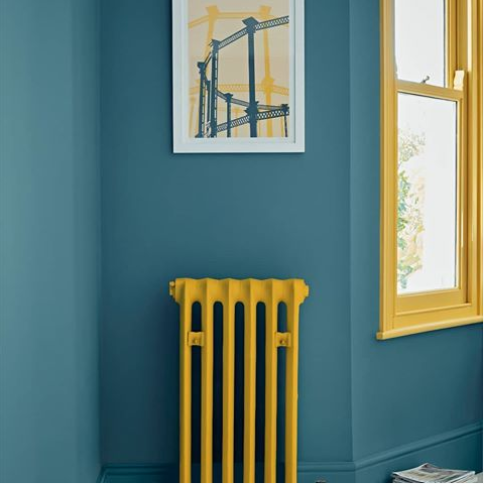
The dreaded radiator.
Maybe you’re lucky enough to have attractive feature radiators in your home. In that case, have fun with your colour choice. I would want it to stand out from the wall, for sure!
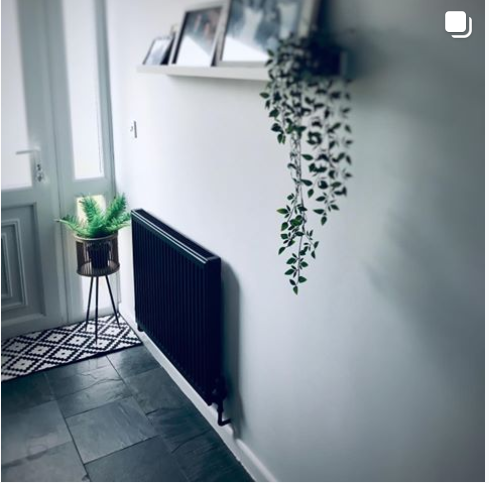
However, for the majority of folks who are living with the bog standard ugly radiator, then the simplist solution is to paint them the same colour as the walls.
Then, instead of detracting from our décor, they blend in and becomes less obvious as the eye travels around the room. We usually don’t want these kinds of radiators to stand out, and if we leave them white, against a coloured wall, that’s exactly what they’re going to do.
That said, you could go the opposite route entirely. To be really playful and dramatic, you could paint the common (ugly) radiator in a contrasting colour, transforming it into a feature. Suddenly, it’s no longer an ugly obtrusion into the overall scheme, but an interesting element that adds to the overall effect.
But coming back to the original point, unless it’s a feature radiator or the wall is white, then the radiator must be intentionally painted to work with the décor. Even if it is currently hiding behind a sofa….should you decide to switch up the layout, your ugly radiator may become exposed.
We’ll look at layout in a subsequent post, as well as some other topics. For now, following are the other posts on colour that I’ve referred to. I hope you find them helpful:
Unsurprisingly, lockdown has stimulated our appetites for home improvement. And this is a good thing for our mental and emotional wellbeing, as our home environment has a huge role to play in that.
Colour in particular has a significant impact on our moods and on our rooms. For that reason, we need to choose our colour palettes carefully and not be overly influenced by what’s trending on Instagram.
When selecting colours for each space in our home, we need to consider the function of that space. Who is using it, for what purpose(s) and at what time(s) of the day? And we also need to consider what direction the space is facing.
The Visual Effects of Colour in our Interior Spaces
So most people probably know that light colours reflect light and dark colours absorb them. Hence, to make a room feel lighter and brighter, paint it a pale colour. And paint it a dark colour to make it feel cosier.
There is another element that is lesser well know: light coloured walls tend to visually recede from us and darker ones appear to move towards us. So a whiter wall will feel farther away from us than a darker one.
And when we can’t physically change the size of a space we use various tricks to play with how the space is perceived. The most impactful of these is colour, and the conventional application of this wisdom tends to be along these lines:
If the room is small paint it white, or at least a pale colour.
If the room is cavernously large, play with darker shades to visually shrink the space and make it feel less cavernous.
These days designers are becoming increasingly fond of bucking this convention however, when it comes to small rooms. Particularly if the small room isn’t south-facing and so is only bright for a small portion of the day, if at all. It’s increasingly popular now to “embrace the darkness” and instead of trying to make a small dark room feel lighter and larger, to work with its natural leanings and opt for making it feel invitingly cosy instead.
It’s an option! If your room is south-facing though and you’re craving a feeling of lightness and spaciousness, then do work with white or pale colours.
And if you’re looking for a light effect, choose finishes with higher sheen as they will also help to bounce the light around the room. (And add mirror and glass to increase light reflection.) If you’re going for the cosy option, opt for more matt and less sheen.
The Effect of Compass Direction on Colour
The direction a room is facing is an important consideration in choosing colour, because the direction will influence the quality of light. And the light will affect how the colour appears on the walls.
Here in the northern hemisphere the brightest and warmest light comes from the south. A south-facing room will be bright for most of the day. A north-facing room will almost always be relatively dull—even if you paint it white.
Warm colour is what you will experience in a south-facing room, an east-facing room in the morning or a west-facing room in the evening. Cool colour is found in north-facing rooms, east-facing in the evenings and west-facing in the mornings.
And the warmth (or lack of it) will affect the colours on the walls.
Colours themselves sit on “warm” and “cool” ends of the colour spectrum. Greens, blues and purples that sit closer to blue than red (eg violet) are cooler. They can be very calming to the psyche, but when used in cooler light they can feel a little clinical and not that inviting—at least when you’re using the pure colour or a lighter tint of it. When you start to move towards darker shades however, then these colours can start to add more cosiness.
Reds, yellows, oranges, purples that sit closer to red than blue, and greens that sit close to yellow are all warmer colours. They will all evoke a more vibrant feeling than cooler colours. However, in strong saturations they will be intense and are probably best used in transitional spaces, such a hall or downstairs loo. They can work well in kitchens and dining rooms too if you want a stimulating atmosphere. In living rooms and bedrooms though, opt for paler tints rather than strong versions of the colour.
Greens and blues will feel more clinical in cooler light and more relaxing in warmer light. So they can be great choices in living and bedrooms if the light is warm at the time that we use them—morning in the bedroom (to encourage us to get up and embrace the day) or evening in the living room (to enhance chillaxability). Naturally we also want our bedroom to feel relaxing and not clinical in the evening time, and this can be achieved by choosing warmer lightbulbs for reading and ambient lamps.
Because of this interplay of light, it’s important to buy tester pots before you invest your time and money in the full paint job! Put swatches on every wall in the room, because the colour will look different on each wall. And check it at different times of day, because it can potentially look like a totally different colour between morning and evening. Give it a few days of examining a few options before you make the call. And choose the colour that gives the effect you want for the time of day you will be using the space.
Colour Psychology
In addition to the effect of light in a room, we also want to consider how we ourselves want to feel when spending time in it.
As mentioned above, both green and blue can be very calming to the psyche. But you’re not limited to these choices for your relaxation quarters. Opting for paler tints of your favourite colour will also help you wind down.
For concentration and focus, look at darker blues verging on navy.
For a cheery effect look at oranges and yellows. Beware of red as it can be a tad too stimulating. In addition to stimulating passion, it can also stimulate tempers so it’s best kept to a minimum in our homes. If you love it and really want it, opt for a darker shade (like burgundy) in the dining room, or a paler tint (like pink) in the bedroom.
Orange can be a good choice in the kitchen and dining room, stimulating appetite and conversation.
And yellow can feel inviting and welcoming in the hallway, or put us in a positive frame of mind in a breakfast room. With both yellow and orange though, the effect can be a bit too stimulating depending on where you land on the colour spectrum. Better to go with a paler tint or a darker shade (like mustard) than a pure sunny yellow, which might give some people a headache if they spend too long in the space.
You gotta love it!
While holding the factors above in mind, the most crucial thing of all is that you love the colour. Don’t put navy in your home office because it helps concentration if the affect that colour has on you is to feel gloomy. Look for a shade of a colour that resonates better with you. Maybe a teal blue instead of navy. Or maybe you need the walls to be blank white spaces so you’re not distracted.
The psychology guidelines reflect what is generally found to be true for most people. But we are each our own person and we might personally buck the trend. These are a good starting point, but remember to cross-reference them with your own preferences.
If your home is going to make your heart sing, you need your colour palette to harmonise with that intention!
So to recap, the main things to consider when choosing your paint colours have nothing to do with the current Colour of the Year. Get clear on:
What kind of visual impact you want to create in the room
What kind of impact you want the room to have on your mood
What effect the light will have on colour choices at the time of day the room will be in use
And then play with the appropriate tints and shades of the colours you love.
We’re all familiar with the phrase, “My body is a temple”. Not so common is the concept that our homes are temples too.
Whether religious or not, we often view the places that are sacred to us as places outside of our homes. They can be churches for some. And equally, they can be the sea or another body of water we love to visit, a local park or a woodland. They can also be theaters, favorite local cafes, restaurants, or even the pub.
We all need places in our lives that help us to recharge our batteries — mentally, physically and emotionally. I have long believed our homes should be one of these places, and we should treat them accordingly.
This lockdown has surely shown us we need to have more than one option when it comes to having a place of sanctuary whenever the need presents. We cannot depend on permanent access to any one spot, so we need to have backups. And we certainly need to be able to create a sense of sanctuary in our homes.
Last week in Ireland we were given a roadmap for the reopening of society and business. On the one hand it’s reassuring to be able to see how we will slowly come out of the lockdown. On the other hand, that certainty means we now know for sure that most of us will still be remaining in our homes as much as possible in the coming months.
Our homes (and gardens, for those lucky enough to have one) will remain the place where we spend the vast majority of our time. They will remain our primary source of sanctuary for the forseeable weeks and months.
Does your home feel like a sanctuary right now?
For people who are living with domestic violence, their homes are not safe places and so expecting them to feel like a sanctuary is expecting too much. Some of the tips below may help ease tensions, if they are possible for you to implement.
For the rest of us, who are not living with an abuser, creating a true sense of sanctuary in our home is achievable for sure — and easier than you may think.
The first step is to shift our perspective. If your home is feeling like a jail to you, then try acknowledging that it is not that. It is a safe space, even if you do feel constricted by the obligation to spend so much time there right now. And the simple act of feeling momentary grateful can help us to reboot from the stir-crazy to a more uplifted feeling.
Switching up the look of our homes can also help us feel better about them and within them. And, unsurprisingly, the lockdown has spawned a lot of interest in home improvement with people digging around in their garden sheds for leftover paint they can use to brighten up their homes. We all know, because we’ve all painted a room at some point, what a difference colour can make to how our homes feel — and to how we feel in a refreshed room.
That said, we don’t have to repaint or redecorate our homes in order to improve their sanctuary-like vibe. Although that can certainly help — if you get the color selection right!
However, to set your home up as a true sanctuary — a place that nourishes your wellbeing on all levels — think more along the lines of temple than magazine cover.
Whether you align with a religion or not, thinking about how temples are used and cared for will help you set your own home up as your (and your family’s) personal sanctuary for your mind, body and spirit:
It will be clean and clutter-free. Yeah, I know, not fun! It is the fundamental step though, like washing our bodies before we put on clean clothes. Of course, different levels of clearing are possible in different households, depending on the age and needs of everyone living there. Where mess is completely unavoidable, is it possible to zone it? Or could you organise your storage better, to create pockets of temporary calm when the lego and other necessities aren’t in use? And clear out what’s definitely past being loved and used — even if it’s only to the car boot, until the charity shops can reopen.
Use sound, mindfully chosen with the intention of raising spirits. Sing, chant, play instruments. Turn off the news and play Mozart in the background as you go about your day to day activities.
Smudge the space by burning incense or herbs. Make sure your incense has natural ingredients, not synthetic, and set an intention around what kind of energy you want your home to support prior to the smudging. What do you and your family need right now? Maybe to feel safe, or to feel trust in how you will all come through this. Do this regularly, and especially after a member of the household has been sick, or after an argument.
No redecorating is required to implement any of these steps, and all will help to create a more nurturing space in your home.
Other simple steps are opening the windows as much as possible to allow fresh air (energy, chi) to circulate through your home. And while we don’t see plants in religious temples, they make a great addition to a home. This is especially true if you have no outside space at all, as plants bring vital living energy into our space.
If your home feels cramped then look at how rearranging the furniture might allow for easier movement around and through the space. As well as improving circulation, rejigging your furniture layout is the quickest (and zero-cost) way to change the look and feel of a room. Many interior designers admit to “shopping their home” regularly, moving rugs, cushions and other accessories from one room to another. I love to do this with furniture too, when I’m not feeling the love for a particular piece. Often, in a different room, and given a different purpose (which improves how the room functions), I change my mind about a piece I might have wanted to get rid of before.
Right now, donating, recycling and free-cycling furniture isn’t an option, so try looking at pieces you wanted to replace in a new light. If moved to a new spot, could they solve a storage or study need?
And, of course, repainting can also help enormously. Color has a huge impact on how we feel, so choose carefully — especially if you want to reduce instances of conflict.
For more peace and calm, go for blues, greens and paler colors. Avoid red in your home. It is very stimulating, and not a good idea if you want to create a relaxing vibe. The best place in the home to incorporate red is the dining room, as it can stimulate both appetite and conversation. However, in a home where tempers are known to flare, it would be helpful to get rid of all red. If it’s on the walls, paint over it. If you have a red sofa or armchair, cover it with a large throw.
Blue and green, the colors of nature, are both calming to the psyche. They are both on the cooler end of the color spectrum too though, so be mindful of that when choosing your shade. In north-facing rooms, blue in particular can make a room feel cold. Green is slightly warmer, as it is blue combined with yellow. In a south-facing room blue and green will feel less cool, while injecting their soothing effect.
If your room is more northerly, then think about paler versions of the warmer colors (red, yellow, orange). Orange and yellow have a cheery effect on us, but in strong saturations they might feel overbearing. If you and everyone in your household love these colors though, then go for it in places like the kitchen, dining room, hallway. Avoid them on the walls in the living room or bedroom, as they are a bit lively for use in places designed for relaxing or sleeping.
If a dedicated working-from-home space is newly required, dark blue or navy is a good choice. It helps to promote concentration and focus. Painting one wall or corner can also help to delineate that zone as separate from the rest of your living space. And avoid it feeling gloomy by adding appropriate lighting.
Lastly, review the art and other knick-knacks around your home. Does it reflect you and your life? Does it symbolically support the journey you wish to take going forwards? If you want your home to feel peaceful and happy, does the art you’re looking at daily evoke those feelings? Art depicting stormy scenarios or sadness might be better swapped out for more joyful scenes. And in the bedroom, be sure you’re displaying symbols of happy couples and not sad or lonely-looking people.
Overall, we want our homes to symbolically represent joy, health, love, compassion and all the other good stuff we wish for ourselves and our loved ones. When we walk through the doors, we want to feel uplifted by the space.
So notice how you feel when you enter your home, and as you move from room to room. If any part of your home has a dragging effect on your energy, then it might be time to apply some of these tips. Start with the free and easy ones and work your way up to the painting. You’ll be glad you did.
I believe that, regardless of ownership, our homes should be true sanctuaries. Our home needs to be a safe space for us to nurture our wellbeing on all levels.
But for those living with domestic violence, staying home does not equal staying safe. Throughout the lockdown I have been thinking about all the people who are in greater danger, not less, because of these restrictions.
I want to help raise funds for Women’s Aid, who are currently experiencing increased demand for their support services. So I am offering virtual consultations throughout the month of May with all proceeds going to the organisation. Better yet, donate what you can afford – normal rates do not apply.
As an interior designer I can help with advice and suggestions on how to make improvements in your home, before we’re all set loose in the DIY stores on May 18th.
The consultation will be 30 minutes. Use this session for help choosing the right colour(s) for various spaces in your home. Colour hugely impacts mood and ability to be calm and focused, and it is greatly affected by light.
Or we can look at potential solutions to current and future challenges you’re facing, such as work/study from home spaces.
If you’re planning on putting your home on the market after lockdown, we could review what preparations you could be making over the next couple of months to improve saleability.
Or maybe you’d just like some suggestions for uplifting and refreshing your home without breaking the bank.
Whatever you need help with, email me on Hilda@hildacarroll.com and we’ll take it from there. If you don’t want a consultation but you’d like to support this anyway, click here to donate.
Let’s make it easier for everyone forced to #stayhome to be able to #staysafe too. Thank you for your support.
If you’re in need of support:
Women’s Aid Ireland National Freephone Helpline 1800 341 900 24 hours a day, 7 days a week
Men’s Aid Ireland Confidential Support Line:01-5543811
Forgive my photography, it’s not a natural skill of mine and now is not the time to invite someone who knows what they’re doing into my home.
I recently gave my living room a bit of a makeover and I’m going to share here some tips for making small spaces feel bigger. In interior design there is some conventional advice for how to decorate small spaces that has a sound logical basis.
Number one on the list is to paint the room or area a light colour, white being the top recommendation. Because white and other pale colours reflect light, painting your walls and ceiling accordingly can help make the room feel bigger.
Conversely, black and dark colours absorb light, and a dark
room generally tends to feel smaller than a light room.
There is another dimension to the light colour advice, and
that is that paler colours appear to recede while darker and stronger colours
appear to advance towards us. So with lighter walls appearing to move farther
away from us, the space feels larger. And as darker walls feel like they’re
closer to us, the space will feel more cramped.
With this knowledge it makes perfect sense to paint smaller rooms light colours to make them feel more spacious, and paint larger rooms darker colours to make them feel cosier. But as I’ll explain shortly, we don’t always need to follow this advice. If your heart is set on a particular colour – and it’s in a strong dark hue – there are other ways to make the space feel, well more spacious.
The other piece of conventional wisdom is to avoid having large furniture in small spaces, as overcrowded spaces will always feel small. This one is a bit of a tweak on what an interior designer would actually advise, which is that the furniture should always be properly scaled for the space it’s in.
However, this doesn’t always mean that smaller furniture will make a room feel larger. In a room that can comfortably take a larger piece, putting in a smaller piece might actually emphasise the lack of spaciousness rather than counteract it.
It is not only ok to put a three seater sofa in a smaller living room – it could help the room feel more spacious than a two-seater would if the piece isn’t ridiculously oversized in proportion to the room itself and all the other pieces of furniture in it.
It is good to know and understand the conventional guidelines, so that you also know when you can break them, and still create a harmonious and balanced effect in the space.
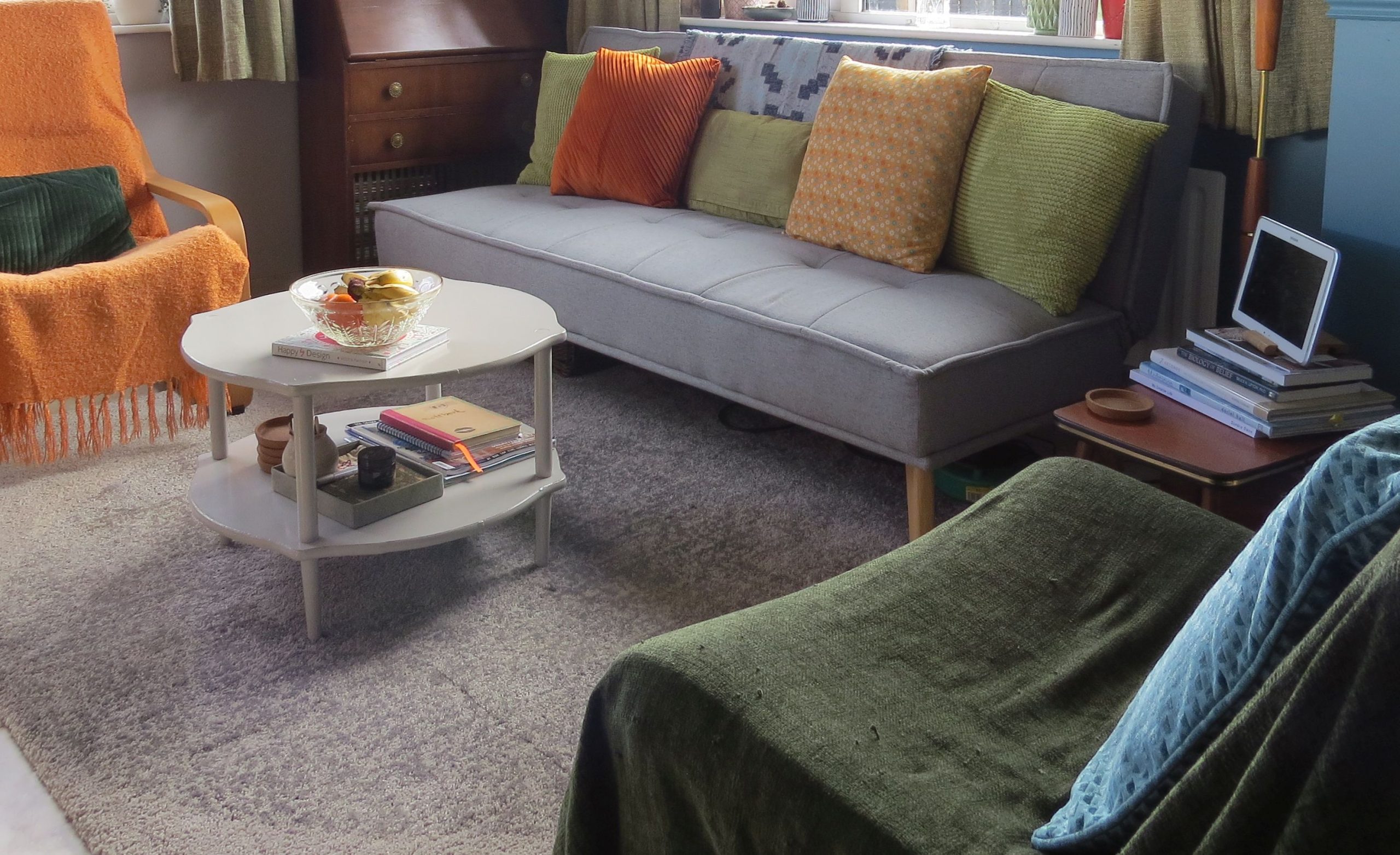
In my recent refresh I made three simple changes: a new wall colour, a new sofa and a new rug.
[masterslider id=”3″]
With a white dado rail, the room was previously painted grey on the lower section and magnolia above. Now it’s painted teal blue from top to bottom on three walls, and grey on the fourth wall. (This is not a feature wall, but a wall shared with the open-plan kitchen where the blue would be too strong with the existing colour scheme).
Effectively, we’ve gone from a paler backdrop to a darker one.
The room does have dual aspect windows – one facing North-East and one facing South-East. They do bring in good light in the mornings, especially during spring and summer. But even during the brighter times of year, the light in this room is much duller from midday onwards. So we would expect painting it a darker colour to make this small space feel even tighter.
And yet, it feels the opposite. This small room feels much more spacious than before despite the darker colour. The magical antidote to the darker walls is the size and colour of the new rug and sofa.
The new sofa is a three seater, whereas the former was a two seater, so I have bucked the conventional wisdom again.
And this hasn’t made the room feel cramped at all. In fact, the sofa helps to counteract the effect of the darker wall and add to the overall roomier feel. There are four factors that help to achieve this effect:
The extra length in the sofa helps to make the space it sits in feel wider than it did when occupied by the old narrower sofa.
The new sofa is a pale grey, compared to a dark blue before. As explained above, the old dark sofa would have absorbed more light than this new one is doing.
The new sofa is on legs, while the old one went all the way to the ground. In a small space, furniture raised up on legs that allows us to see floor space underneath is a much better option. Being able to see more floor space contributes to the illusion that there is more space overall.
The new sofa has a much lower and slimmer profile and takes up far less visual space, even though it is a physically larger piece of furniture. Chunky pieces aren’t friends to small spaces – the sleeker the better. And sleeker can often allow you to fit something bigger in if its visual weight is proportionally in keeping with the available space.
The new rug has also helped to make the space feel roomier despite the new darker walls.
And again, this is due to the combination of its light colour and larger size. Large enough for all seating in the room to partially fit on the rug, and running underneath the sofa, it is also helping to create the illusion of a larger space.
The end result of this little refresh is that, when sitting in this room during the day, it feels a lot more spacious than it did before.
And this is despite the new layout. Previously the armchairs were placed so as to open up the sitting space more. Now, the layout encloses the sitting space and it still feels bigger than before.
In the evening, when the curtains are drawn and the lamps are lit, the room feels about the same as before space-wise. However, the darker colour has made it feel much cosier as an evening retreat.
One last helpful tip…both these windows had a dark roller blind, which I never used. Although they were rolled up quite high, I did remove them altogether and this too will have helped introduce more light.
Still to come… a larger coffee table surface. This one is not quite the right size. And I plan on painting the door the same colour as the wall. So watch this space….
In Denmark, hygge is a year-round practice and it’s not improbable that it contributes to their enviable levels of happiness and wellbeing.
More than candles, hot drinks and cosy throws, hygge is
about a way of being…being present, being grateful. Slowing down and
appreciating the simple things in life.
Amidst all the fear and uncertainty that we’re all dealing with at the moment, many of us also have this gift – the opportunity to slow down and appreciate the simple things.
We can appreciate our own health and that of our loved ones if we are all remaining well so far. I don’t think anyone is taking that for granted right now.
We can appreciate our homes and take the time to show them
some love by cleaning, decluttering and organising them. They don’t need to be
insta-worthy show homes to feel like true sanctuaries.
We can create some rituals to support our wellbeing, in whatever ways we feel are good, and manageable, for us right now.
Rituals are an integral part of hygge. And these can be very simple. As simple as brewing a morning cuppa and taking the time to sit and sip it, mindfully enjoying every drop rather than multi-tasking while we gulp it down.
What would be a good – and workable within your own
constraints – morning ritual that you could practice now to set you up
physically, mentally and emotionally for the rest of the day?
Some form of movement would be extremely supportive, if you are physically able. And there’s an abundance of yoga, pilates and fitness instructors offering their classes online right now. And many are doing so free of charge.
As a meditation teacher, I’m always recommending building
this practice in to our morning routines, even if it’s just for a few minutes.
And another great way to set yourself up for the day is to
write “Morning Pages”. This practice takes about ten to fifteen minutes, and
involves free-writing without any premeditation or censorship. Just write
continuously whatever pops into your head, for three pages.
Effectively this is a brain-dump and it helps to clear our
minds of whatever might be clogging them up, leaving us sharper and more focussed
when we move into our daily activities.
And then, of course, we can also embrace the Instagram-depicted elements of hygge. The cosy throws, the fires (if it’s still cold where you are), the candles, the hot drinks. Scatter these feel-good touches throughout your day and savour them as delightful treats.
Another important aspect of hygge is connection with loved
ones. I think most people are already doing this on an uplevelled scale right
now. We may be physically separated, but connection via social media and online
technology is going through the roof. No longer taking chats with family and friends
for granted, we seem to have embraced en-masse an appreciation for the simple
ability to check-in with people. And the appreciation amplifies the benefit of
this contact.
Hygge is about being appreciative of what’s good in the moment,
and making the moment as good as it can be. And we seem to be making great strides
in this, in between our bouts of worry and sadness.
The worry and sadness are natural emotions and not to be suppressed. When we allow ourselves to feel them fully, they pass more quickly than when we try to deny them.
And once they have passed we can go back to finding a way to make the most of this time. Wishing you a hyggeligt lockdown.
Feng Shui is widely misunderstood in the western world as a manifestation tool.
This is unsurprising given that it’s so often peddled as just that. And people have mixed results—for some it works like a charm and others have frustratingly poor outcomes.
The reason for this is that Feng Shui will be far more effective when we apply it as a personal development tool, rather than just a manifesting one. It can actually be a powerful manifesting tool, but most effectively so in the context of personal development than simply pursuing ego-based goals.
In the East, Feng Shui is regarded as a sacred spiritual practice and there are different schools with different guidelines. In India, there is a Vedic equivalent called Vastu Shastra. Both practices divide the home into zones that correlate with different areas of our lives, and both have guidelines around what items to place and where to place them around our homes to enhance results in different areas of our lives.
But here’s the thing—the area of your home that corresponds with that part of your life varies, not only between Feng Shui and Vastu Shastra, but also between classical and “Western” Feng Shui with one using the compass and the other version using the location of the front door as yourBaguaguide. And there is also variation in the cures for problems presented by the architecture of the building.
So, if we simply decide to adopt one of these practices and follow their guidelines, without having any lifelong cultural investment in their power, then a lack of external results is highly probable.
To apply them effectively, we need to use them to help us excavate what and where our inner blocks might be. Whichever system we choose to apply, consciously dividing up our homes into zones that represent different aspects of our lives—health and wellbeing, wealth, personal development, and so on—can help us shine a light on where we’re energetically neglecting these parts of our lives.
Inside-out:
Once you’ve applied the Feng Shui bagua to your home, go to the areas that correlate with the aspect of your life that you’re looking to improve. And then look for the clutter. Whether it’s just a drawer or the whole damn room, set a clear intention around what changes you want to make in this aspect of your life. Or maybe it can be an intention to receive clarity or to open up to guidance. With your intention set, start to declutter, clean, and organise.
Outside-in:
If you find that clutter tends to pile up in a particular spot in your home, check which part of your life that correlates to. And then ask yourself how things are going there. For example, if the spot correlates with romantic relationships, ask yourself if you’re happy with your current status. If in a relationship, is it good? Are there issues? If so, what are they and how can you (not the other person) create positive change? Again, set an intention to receive clarity and insight into how you might improve the situation before you clear, clean, and organise this spot.
Despite the variations in specific guidelines between different schools, the fundamental shared philosophy is that our homes are containers for our energy.
While our bodies are temples for our souls, our homes are temples for both. And to keep our physical, mental, and emotional energies as clear and free-flowing as possible, it’s vital to allow the energy in our homes to be able to circulate freely and easily, too.
This is why every Feng Shui consultant will advise you to start with decluttering. It’s important not to cram our homes to the rafters, but to fill them only with items that we need (use regularly) and that we love (gives us an energetic boost every time our eyes alight on them).
After that, they look at where and how items are placed throughout our homes and what they might potentially symbolise for the corresponding life aspect. For example, lots of images of women on their own won’t be helpful in attracting a partner if you’re a single woman. Instead, they’ll programme the subconscious to maintain the solo woman status quo.
For that reason, Feng Shui consultants always recommend images of happy couples to be placed in the relationships area of the home, and especially in our bedroom (which is always a relationship hotspot, regardless of where “Relationships” officially falls in our bagua).
It doesn’t matter so much which school of thought we’re following, as how mindful we are being about everything we’re placing around our home and what each thing means to us. We need to read the symbolism of what we’ve placed throughout our home and question whether it’s helpful to keep each item, or maybe consider moving it to another spot.
And we need to let go of the expectation that “feng shui-ing” our homes for romance or any other particular outcome will inevitably lead to the results we want. This is where the frustration and disappointment can arise for many. We can make all the perfect placements and put all the right cures in place, but if we haven’t got in touch with what the internal blockage is, then it’s not likely to lead to lasting results.
As within, so without.
Our homes can help us look in the mirror and see where we need to redirect our energy, and where we need to focus some self-care and healing attention. Which brings it back to being a spiritual or personal development practice. And as with many such tools and practices, when applied mindfully they can lead to surprisingly wonderful results in our lives.
Some might call that manifesting what you want. Others might call it allowing for your highest good to unfold. Whichever direction you want to go in, clearing out your home is always a wonderful starting point.
It helps us to bring a mindful awareness to where we’re coasting, where we’re putting too much energy, and where we’re not putting enough. And we can use it as both an inside-out and an outside-in tool.
Spring cleaning and decluttering our homes makes them far more pleasant spaces to spend time in…need I say more in the current circumstances?
It’s the time of year for it anyway, and with all the extra time we’re spending at home it’s a perfect opportunity to tackle it.
I started a couple of days ago with my entryway and yesterday I tackled my kitchen. Today I still have plenty to do in the kitchen – the more hidden areas. But the external area of the kitchen is now making my heart sing and I’m happy to cook and eat there again. (And do what work I do have left at the kitchen table – I have mostly been doing that from the sofa.)
I’ve made a short before and after video of both my kitchen and entryway, in the hopes that it will motivate you to join in with me. They’re all on my Facebook page and you can view them on the following links:
If you have kids at home with you who are old enough, get them involved – it’s an important life skill so qualifies as home-schooling, methinks. 😉
Next up for me will be my bedroom and bathroom. Followed by living room and the middle hallway (that I pass through a gazillion times a day).
I’m aiming to complete my entire home this week. But if you’d prefer a baby-steps approach then my 30 day decluttering challenge might help. That’s a free resource that you can get here.
If you’re just getting started, here are some meditation guidelines to bear in mind. Because it’s quite common that people’s preconceptions don’t match their experience….
They expect to have a still mind….and their mind remains busy.
They expect to feel bliss…and they experience boredom.
They expect to have a profound experience…and they don’t.
They expect it to be something other than they experience…and they are disappointed.
If developing a meditation practice is one of your goals for this year, I would suggest you lower your expectations before you even start.
Meditation can be very simple if we don’t put too much pressure on ourselves to have any particular experience, achieve an altered state, feel completely relaxed and blissed out.
I would encourage you to go into the practice with no expectations whatsoever around what you may experience. Instead, go into it with the simple intention to do it for an agreed upon (with yourself) time period and stick with that, even if you feel bored and want to stop.
That period can be as little as five minutes if that’s all you can spare for now. View your meditation practice as a fitness regime for your mind and spirit. Like a physical fitness regime, the benefits accumulate gradually over time. You won’t get fit from a single five minute walk. But a daily five minute walk slowly improves fitness. Increase that to a twice daily ten minute, or twenty minute walk and your fitness level will greatly improve.
And so it is with meditation. Twenty minutes twice a day will show faster results, but five minutes once a day is absolutely worth doing, if that’s all you have right now. It’s better to start with five minutes now than to wait another week, month or longer until you have the time to devote to longer sits. All those scientifically endorsed benefits meditators enjoy aren’t derived from procrastination. They accumulate from taking time out of our day to practice a little self-care.
Make Peace With Your Busy Mind
Once you’ve agreed with yourself that you are going to do it, the next important point to bear in mind is related to the busy-ness of your mind. While meditation is a process of quieting our minds, it is a normal experience to have thoughts continually interjecting throughout the process. Please don’t expect complete stillness – you will be disappointed.
The process of meditation requires us to become aware of our continually wandering minds and bring them back to a point of stillness. We use something to focus our attention. It might be our breath or a mantra. And when we become aware of our wandering thoughts, we choose to return our attention to our point of focus. And we repeat that ad nauseum until the time is up.
Speaking of which, do use a tool to time yourself. Something with a non-jarring alarm to arouse you. If using an app on your phone, remember to put notifications on silence until you have finished.
Keep It Simple
And now you’re ready to start. Begin by sitting in an upright position with your back straight, your shoulders down, and your feet planted firmly on the floor.
Lower or close your eyes to eliminate visual distractions.
Place your attention on your breath and observe its flow without changing its natural rhythm.
Notice that you’re breathing in.
Notice that you’re breathing out. (To help keep your attention on your breath, you could silently comment: “I am breathing in. I am breathing out.”)
Each time you notice that your mind has wandered off – and there will be many – simply bring it back to your breath.
When the time you’ve allocated is up release your attention from your breath and allow it to focus on sounds in the room and beyond.
Bring your attention back to your body and notice any sensations. Notice how different parts of your body connect with the chair and how your feet connect with the floor.
And when you have grounded your attention back in your physical body, you can slowly blink your eyes open.
Don’t Judge Your Experience
The point of meditation is not to be a pleasant or relaxing experience, although it often is. (And equally so, it often is dull.) We meditate in order to improve our wellbeing on all levels. As already mentioned, those benefits accrue gradually and as they do so we get to enjoy them as we go about our everyday lives. So if the time we spend in the practice itself is pleasant, that’s an added bonus.
With practice, we can come to enjoy it even if it feels boring when we’re starting out.
Practice Is Key
To maintain the benefits from meditation, we need to make it a regular practice. Daily is best. Ideally, we would meditate first thing in the morning and also in the early evening. For practical reasons this doesn’t always work for everyone. However, if you’re going to make it a daily habit then you need to weave it into some part of your daily routines.
Morning really is best, if you can manage it. Most of us have some kind of morning routine – a general order in which we do things when we get up and start moving about, especially on work and school days. If we integrate our morning meditation into this daily routine, before long, it becomes habitual.
So I highly recommend you set your alarm a little earlier than usual and do it before you do anything else (after going to the toilet).
One of the many documented benefits of meditation is that we feel rested and energized afterward. Meditation gives us such a deep level of rest (even if it doesn’t feel like that because our minds continue to be busy throughout) that it more than makes up for the extra few minutes of sleep we’ve sacrificed.
So it is well worth the effort to get up just a smidge earlier and give it a go. And if you miss a day, that’s no harm. Just start over again tomorrow.